
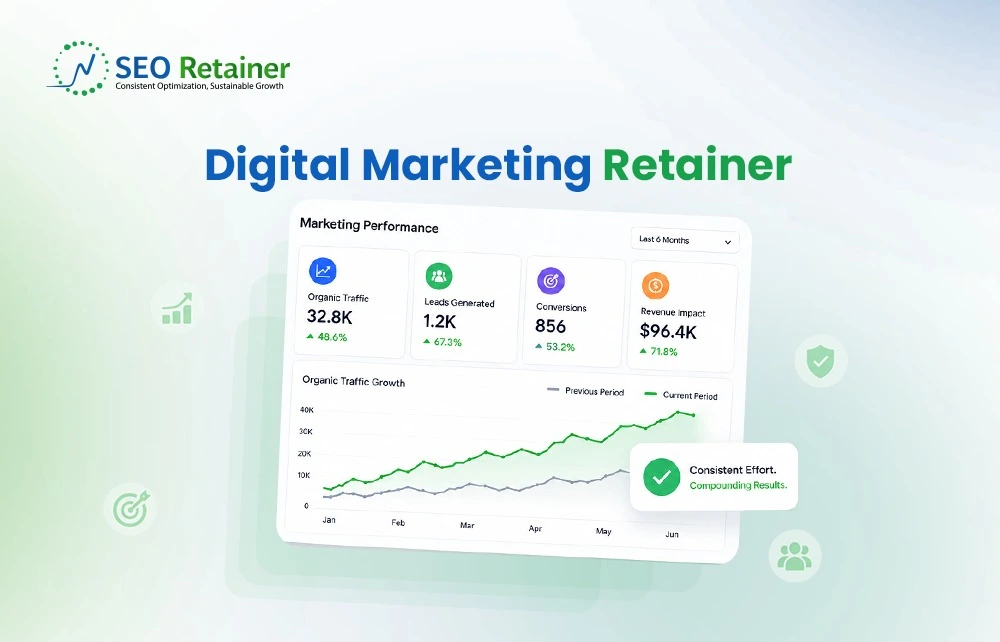
A digital marketing retainer is a service model where you pay an agency to do marketing for your business every month on your behalf. This retainer helps your business drive more traffic, leads, and sales, but remember it will happen only if it is done right. We have seen that a lot of the time, it is not done in the right way.
Let’s show you a scenario we have seen a lot of business owners face. Some business owners talk to an agency and feel excited, and right then sign the contract. A few months later, the business owner notices no improvement at all. The traffic is the same, leads are the same. Then the agency sends a big report full of charts, but nothing makes sense.
If you have ever gone through those kinds of situations, or thinking to take digital marketing retainer for the first time, this guide is for you, not for the agency. When you finish reading, you will know what a good retainer looks like, what it costs in 2026, and how to make sure you never waste your money.
What Is A Digital Marketing Retainer? (And What It Isn’t)
A digital marketing retainer is a monthly contract where you pay a fixed amount to an agency. They do your marketing work every month, such as SEO, content, ads, and social media. It is like having a marketing team. But you do not hire them full-time. You pay one monthly fee and get writers, designers, and SEO experts all in one place. They become your main marketing partner.
On the other hand, a retainer is not a project. A project has a start and an end. A retainer keeps going every month for as long as it is working for you. But a retainer does not cover everything.
Here is what it does not do:
- Extra work outside SLA: If you ask for extra work that was not in the plan, you pay more. The team cannot just do it for free.
- Nobody can promise exact sales: No agency can promise you fixed numbers of new customers next month. If someone says that, do not trust them.
- You cannot change direction every week: The plan needs time to work. If you keep changing it, you will not see results
Good marketing takes time. SEO alone takes 6 to 8 months to show real results. A retainer works because the team keeps doing the work every single month. That is how you grow.
How a Digital Marketing Retainer Works
A digital marketing retainer is simple to understand and work with. It follows the same steps every month.
Here is how it works:
- Onboarding and audit: First, the agency learns about your business. They look at your website and your marketing. They find out what is good and what needs to be fixed. Now they know where to start.
- Strategy and roadmap: Next, they make a plan. The plan says what they will do and what the goal is. You both read the plan. You both agree. Then the work starts.
Monthly execution: Now the team does the work. Every single month, they write content, run ads, and fix your SEO. They just do it, & you do not have to ask. - Review and adjustment: At the end of the month, you talk together. You can look at the numbers about what worked, what did not. Then you fix the plan for next month. Bad results get changed, and good results get more attention.
Same four steps every month because the plan is simple to get better over time.
What Does A Digital Marketing Retainer Include?
The tasks in your monthly plan change based on the money you pay. A small plan for a local shop looks very different from a big plan for a global brand. To see where your money goes, you must look at core services and extra add-ons.
Here is what most plans include:
- Strategy & Planning
- SEO Services
- Paid Advertising (PPC)
- Campaign Management
- Content Creation
- Social Media Management
- Email Marketing
- Reporting & Analytics
Some of these are the core tasks, and every digital marketing plan has them. The rest are extra tasks you can add on when you are ready to do more.
Strategy & Planning
A good digital marketing service provider always makes a plan first. They never just start working and hope for the best. Let’s take a look at how they make their strategy.
- Checking competitors: The team looks at your competitors. They find out what your competitors are doing. They also find the weak spots and missed chances. That is where you can win.
- Big plans: Every three months, the agency writes a big plan. This plan says what your goal is. Do you want more leads? More sales? More traffic? Or do you just want people to know your brand? The plan also says which channels they will work on and why.
- Monthly meetings: Every month, you sit down together and look at the numbers and insights. Then you talk about what worked and plan what to do next.
The strategy and planning also tell you what to expect:
- After 30 days, what should happen.
- After 60 days, what should be improved.
- After 90 days, the big achievement.
And if something is not working? The team changes the plan. A good agency does not keep doing the same thing when it does not work. They fix it fast and tell you what they are doing differently. That is what a real plan looks like.
SEO Services
Basic plans only cover technical audits, and link building is an add-on saved for mid-to-upper tier packages. If your website is not showing up on Google, you are basically invisible. And invisible businesses do not grow.
Most decision-makers think that SEO is a one-time fix, but the truth is, it is not. You have to show up every month; otherwise the results disappear. That is exactly why many businesses invest in SEO retainer services, ensuring their website is consistently optimized, monitored, and improved over time.
- Technical SEO audit and fixes: Every month, the team goes through your website. And looks for anything that might hold you rank back. Broken links, slow load times, mobile issues. The small technical stuff that quietly kills your rankings if nobody is watching.
- On-page optimization: Your hired agency makes sure the right keywords & LSI are in the right places on your webpage. Page titles, headings, meta titles, and meta descriptions all need to be written according to Google’s provided regulations. Your digital marketing retainer team makes sure they do.
- Content creation and refresh: At least one piece of content gets created or updated every single month. Google rewards websites that stay active and relevant. Old dusty pages do not rank.
- Backlink monitoring and building: Links from other trusted and similar niche websites create a better impression to Google. A good agency brings those links for your site and keeps an eye on your existing links to make sure nothing is quietly dragging your rankings down.
- Monthly Search Console review: Every month they check in on how your site is actually performing in Google, which keywords are picking up, and where the next big opportunity is.
SEO is slow at first. But done right every month, it compounds. Twelve months in, the results speak for themselves.
Paid Advertising (PPC)
Running ads without someone watching them closely is just burning money. This is where a good agency earns its fee.
They do not just set up your campaigns and walk away. They manage, test, and improve them every single month so your budget works harder over time:
- Campaign management: A good agency runs your Google Ads or Meta Ads campaigns end to end, from setup to daily monitoring. They leave nothing to do later or on autopilot.
- Bid optimization and audience refinement: Also adjust your bids and tighten your targeting as the data comes in. So your ads reach the right decision-makers at the right cost.
- A/B testing: Your hired team tests different ad copy, headlines, and angles against each other. Best-performing strategies stay, and flop strategies get removed. Your results improve after every campaign.
- Monthly spend review: At the end of every month, the agency reviews where the budget went, what it returned, and where to shift spend next month for better results.
The retainer covers the management work. What you pay Google or Meta directly is a separate ad spend budget and sits outside the retainer fee entirely.
Campaign Management
Paid ads need daily care. This service covers the day-to-day work on your ad channels:
- Ad Tasks: Digital marketing retainer service provider agencies offer you a specialized ad management team. This dedicated team manages your Google Ads and social ads on Facebook, Instagram, LinkedIn, and more. Every day, they change bids, move budgets to good ads, and fix targets.
- Testing: They run ongoing tests on ad variations. They try different headlines, pictures, and buttons to see what makes people click.
Your retainer fee only pays for brainstorming and time of the respective team, and your ad spend budget is separate. You must pay Google and Meta directly for the ad space.
Content Creation
To stay relevant, you must share good content on a set schedule. This service gives you real assets each month:
- Blogs and Social Media: The agency writes deep blog articles to answer customer search queries. They also plan and schedule social media posts.
- Emails and Pages: The team writes newsletters to keep your leads warm. They also craft direct copy for your ad landing pages.
- Copywriting: Your digital marketing retainer provider manages all copywriting from homepage to product description.
- Ad copy: Your provider agency writes short, punchy copy for your paid ads across Google, Meta, or LinkedIn. Every line will be written to stop the scroll and get the click.
Every piece of content must tie back to a clear strategy. An agency should never make generic posts just to check a box.
Social Media Management
If your social pages are quiet, people think your business is closed. That is bad for trust.
A good agency keeps your pages active every single month:
- Content planning and scheduling: The team plans all your posts before the month starts. They pick the best days and times to post. You never have to think about what to post.
- Community management: When people comment or send messages, the team writes back fast. This makes your brand feel real and friendly.
- Platform strategy: Not every business needs every platform. The team picks the right ones for you. LinkedIn for business clients. Instagram for products. Facebook for local shops.
- Performance tracking: Every month the team looks at what posts did well and what did not. Then they use that to do better next month.
Good social media builds trust. And trust brings customers.
Email Marketing
Email is still one of the best ways to make money online. But only if someone does it right.
A good agency does not just send emails. They build a system that turns your leads into buyers:
- Email campaigns: The team writes and sends emails to your list every month. News, offers, or updates. Every email has one clear goal.
- Automation sequences: When someone joins your list, emails go out on their own. Day one, day three, day seven. You do not have to do anything.
- List management: The team keeps your list clean. They remove people who never open your emails. A clean list means more people see your emails.
- A/B testing: They test two subject lines or two layouts. The one that gets more clicks wins. Then they use that one going forward.
A good email system works every day in the background. You focus on your business. It handles the follow-up.
Reporting & Analytics
If you do not know if your marketing retainer is paying off or not, then something is already going wrong. A good agency always offers you a tracking system and asks you to go through the performance reports regularly.
- Dashboards: A digital marketing agency connects your site to tools like HubSpot, Databox, or Looker Studio. Most of the agencies will give you 24/7 access so you can check in whenever you want. So you don’t need to wait for someone to send you an update.
- Monthly reports: At the end of every month, you get a proper report. Not a wall of numbers nobody asked for. The good ones actually tell you the story behind the data and what comes next. Every report should cover:
- Monthly performance covering traffic, rankings, and conversions
- A clear explanation of what changed and why
- Next month’s priorities and roadmap
Account Management & Communication
Good plans rely on clear talk. Your fee pays for a dedicated account manager who learns your business:
- Steady Talks: You get a strict schedule with short weekly check-ins and deep monthly calls.
- Tracking Tools: The team gives you a login to project tools like Asana or shared sheets so you can watch tasks move.
- Fast Answers: Your contract must state clear reply times so the team cannot ignore your emails.
How Much Does A Digital Marketing Retainer Cost?
A digital marketing retainer normally costs between $1.5k and $30k per month depending on the service level agreement. The retainer’s exact price relies on some specific things. Such as how big your project is, how many channels you need to be covered, and how experienced and big the team is. In 2026, most agencies price their retainers across four tiers, and what you get at each level is very different.
The Clear Digital Marketing Retainer Pricing Tiers
The following table breaks down exactly what your business should expect to pay and what you should receive at every budget level:
| Tier | Monthly Cost | Best For | Typical Inclusions |
|---|---|---|---|
| Entry-Level | $1000 to $2500 | Small businesses, single channel | 1-2 channels, basic reporting, limited hours (20/mo) |
| Mid-Level | $3000 to $7500 | Growing SMBs | Multi-channel, strategy & execution, monthly reporting, dedicated AM |
| Full-Service | $8000 to $15000 | Scaling businesses | SEO, PPC, content, social, analytics, quarterly strategy |
| Enterprise | $15000 to $30000+ | Large businesses, aggressive growth | Full team, advanced automation, custom reporting, CMO-level strategy |
Additional Pricing Context to Track
Most digital marketing agencies charge between $75 and $400/hour. It actually depends on which agency is doing your work. If they manage your paid ads, expect a management fee on top, usually 5% to 20% of your ad spend. Reporting tools like Databox or HubSpot add another $100 to $500 a month.
Digital marketing retainer for the B2B industry costs more. It’s between $5k and $20k a month. Because the sales cycle is longer & super complex. E-commerce and retail-focused plans cost less. It’s around $2k to $10k. But here is what most people get wrong. They focus on the monthly fee instead of the total cost to see results.
A cheap agency at $3k a month that takes six months to move the needle costs you $18k before you see a single return. A better agency at $8k a month that delivers in three months costs $24k total but gets your business growing faster. The math usually favors paying more for the team that actually knows what they are doing.
Retainer vs. Project-Based vs. Hourly: Which Model Is Right For You?
Many business owners rush into a monthly plan too fast. You should never assume a monthly plan is the automatic right choice. To make the best choice, compare a monthly SEO retainer vs one-time SEO project before choosing a plan.
The Hourly Plan
With this plan, you pay for every single hour the team works on your account.
- Best For: Small fixes, quick phone calls, or a basic check of an old ad account.
- The Big Risk: Your monthly costs can change wildly and scare you. Also, the team does not have a reason to work fast because they make more money when tasks take longer.
- When to Use It: Use this when you want to run a small test with a new company or when you need a single planning class.
The Project Plan
This plan uses a fixed, one-time price for a clear job with a hard final deadline.
- Best For: One-time creative builds like a brand new website, a new logo, or setting up a new email system from scratch.
- The Big Risk: Extra work can ruin your budget fast. If your needs change even a little bit, the team will stop working and demand extra money.
- When to Use It: Choose this when you know exactly what you want to build and have a strict final deadline.
The Monthly Retainer Plan
This plan relies on a steady monthly fee that gives you priority access to a full team.
- Best For: Marketing areas that need daily care and steady work to grow, like Google search, paid ads, and weekly email notes.
- The Big Risk: You can easily pay for hours the team did not use if you do not check your reports. You can also lose track of your costs if your contract does not have clear rules.
- When to Use It: Buy this plan when you have long-term goals, a stable budget, and need steady power to win your market.
Who Should NOT Choose a Monthly Plan?
Do not sign a monthly plan if your company does not have clear, long-term goals yet. If your monthly money goes up and down like a rollercoaster, a steady monthly bill will stress your business. Finally, if you just need one asset built once, like a single video or a single sales slide, stick to project pricing.
A Simple Rule to Use
Use this easy rule to help you choose the right path:
- If the marketing work grows stronger over time (like Google search, blogging, and weekly emails), a monthly retainer plan makes perfect sense.
- If the task is a one-time piece of art (like a website, a new logo, or an initial ad setup), a project plan fits your business much better.
Hidden Costs In Digital Marketing Retainers (Read This Before You Sign)
The easiest way to trust a new marketing company is to read the fine print before you sign. Many companies show you a beautiful, low price at first. But they leave out extra fees that show up later on your bills. To keep your money safe, look out for these common hidden costs:
- Ad Space Money: Your monthly fee only pays for the team’s time and brains. It does not pay for the actual ads on Google or Meta. You must use your own credit card to buy that ad space from those sites.
- Computer Tool Fees: Making clean data reports uses expensive software. Many teams charge an extra $100 to $500 each month to cover tools like Databox or HubSpot.
- Making Custom Videos: Standard plans only cover basic pictures and words. If you need fancy video ads, you must pay a separate fee of $1500 to $3000 for every single video.
- Building New Web Pages: Writing words for a page is standard work. But coding a brand-new page template from scratch is extra work. Teams will bill these pages as separate items.
- First Month Setup Fees: Setting up tracking codes and cleaning up old accounts takes a lot of hard work. Most teams charge a one-time setup fee between $500 and $2,000 during your very first month.
- Paying Social Media Stars: If your ads use famous online stars, the agency will charge $2,000 to $4,000 a month just to talk to them. You also have to pay the stars their own money on top of this fee.
- Extra Edit Charges: Free edits do not exist. If your team asks for too many rounds of changes on a blog or picture, the agency will charge you extra hourly fees.
Compare Carefully
Look closely at your choices. One company might offer a $2000 plan that includes strategies, tracking, ad management, page edits, and reports. Another company might offer a $2000 plan that only covers simple ad checks.
The first plan gives you much more value for your money, even though the monthly price looks exactly the same. Always ask for a clear list of every extra cost before you sign your name.
How To Judge Whether Your Digital Marketing Retainer Is Actually Working
Many business owners stay with bad marketing companies for a long time. They do this because they do not know what a good monthly report looks like. To keep your partner sharp, you must check your results every single month.
What a Good Report Includes
A great monthly report is clean and easy to read. It must include these five things:
- Real Goals: The report must focus on real sales and leads. It should skip useless numbers like page views.
- Goals vs. Results: It must show your exact target, what the team achieved, and the gap between those numbers.
- Clear Meanings: The team must explain why your numbers went up or down. They should not just hand you charts.
- Next Month’s Plan: The report must list the exact tasks the team will do next month to fix problems and grow.
- Channel Breakdown: You need to see exactly how much money came from Google search versus paid ads.
Bad Signs to Watch Out For
Watch out for these big red flags that show your plan is failing:
- The report only shows clicks but hides your real sales data.
- The summary feels generic and does not talk about your main business targets.
- The team does not tell you what they will change next month to get better results.
- The report consistently arrives late, or you have to send angry emails to get it.
Good facts show that marketing companies that report on real, meaningful metrics keep their clients 40% longer than teams that hide behind confusing words. Always demand a clear report to keep your budget safe.
Red Flags When Evaluating a Retainer Agency
When you talk to a new marketing company, you must stay very alert. Watch out for these ten bad signs during your business conversations:
- Guaranteed rankings or lead volume: No good company can promise you the top spot on Google. Search rules change all the time, and no human can control them.
- Vague scope: Words like “marketing support” do not show a clear plan. If the team does not list the exact number of articles and posts, you will have angry fights later.
- No ownership of ad accounts: The company should never hide your Google or Meta ad profiles. If you cannot log in to see your daily history, cancel the deal.
- Unwillingness to negotiate contract terms: A standard contract is just a starting point for both sides. If a sales team refuses to adjust simple rules to make you feel safe, they will be hard to work with later.
- No case studies or references: Experienced teams should easily show you real data results for similar stores. If they hide their past work, they lack real skills.
- Short average client tenure: Ask the team how long clients stay with them. If most customers leave in three or four months, it proves the company fails to bring real value.
- “Strategy support” means one quarterly call: Many cheap plans promise expert strategy but only give you one short phone call every three months. Force them to explain their planning process clearly.
- Cheap base retainer with lots of add-ons: Very low entry prices hide the real cost of business by charging extra fees for basic tasks later.
- No AI disclosure: In 2026, companies must tell you if they use smart computer tools. Hiding these tools shows that the team lacks honesty.
- Net-60 or Net-90 payment terms only: Waiting sixty or ninety days to pay is a bad setup. Always ask for normal Net-30 rules or a clear upfront deposit instead.
Questions To Ask Before Signing A Digital Marketing Retainer
Before you sign your name to a monthly contract, you must ask direct questions. Act like a sharp boss to find out how the company really works.
Scope & Deliverables
- What exactly is included in the monthly fee? Ask for a breakdown by hours allocated to strategy, execution, reporting, and meetings.
- What specifically triggers extra billing? Know what tasks will make your cost go up.
- Who is doing the work: senior strategists or junior coordinators? Find out if top experts or new learners handle your ads.
Performance & Reporting
- What KPIs will you track, and how do you define success for a business like mine? Make sure they trace real sales, not just clicks.
- Can I see a sample monthly report? Check if their past reports are clean and easy to read.
- How long before I should expect to see measurable results? Ask for an honest timeline to see your money come back.
Relationship & Process
- Who is my dedicated account manager, and what’s their background? Meet the person who will talk to you every week.
- What project management tools do you use, and will I have access? Ask for a personal login to watch their daily work.
- What’s your average client tenure? See how long other stores stay with them.
Contract & Exit
- What are the termination terms? Look for a 30-day notice, not 6-month lock-ins.
- Who owns the ad accounts, data, and content created during the engagement? Ensure you keep 100% of the tools if you leave.
- How do you handle scope creep? Do you eliminate lower-priority work or quote add-ons separately? Know how they protect your budget.
What A Good Digital Marketing Retainer Contract Looks Like
A good contract is a serious legal rulebook. It protects your cash and guides the team’s daily work. A well-written agreement must include these key clauses to keep both sides happy:
- Defined scope of work: The text must list every deliverable, channel, and deliverable volume. It should say: “4 SEO blog posts per month, 15 social media posts, 1 email newsletter.”
- Revision limits: You must cap rounds of revisions. For example, two rounds are included, and additional rounds are billed at $X/hour.
- Communication protocol: The text must define your channels, meeting frequency, and response times. It can say the team must reply to emails within 24 hours.
- Performance review cadence: You need a set time to talk. Both teams should use quarterly reviews to assess whether the scope still matches current business needs.
- Termination clause: A standard contract uses a fair 30-day notice. Avoid one-sided termination terms that lock your money down for a whole year.
- Ad account & data ownership: The client always owns their accounts and data. You must retain 100% ownership of your pixels, codes, and graphics from the start.
- AI disclosure clause: In 2026, contracts must specify which AI tools the team uses. It must confirm your private client data is not used for public model training.
- Scope creep handling: The contract must specify whether overages eliminate lower-priority tasks or trigger separate add-on quotes to keep costs safe.
A Vital Rule for Growth
Retainer agreements should include a clear mechanism for quarterly scope reviews. As your business evolves and fresh data accumulates, your mix of services should adapt. A fixed, unchanging retainer scope that runs for 12 months is a missed opportunity to make more money.
Is A Digital Marketing Retainer Right For Your Business?
A digital marketing retainer is right for your business if you have ongoing needs for marketing purposes with a consistent budget and a long-term growth goal. A retainer is not the right fit for one-time projects or short-term campaigns. If you need marketing help regularly, like every month, a digital marketing retainer is a perfect choice. If you need it just once, hire for the project instead.
You are a good candidate for a retainer if:
- You have defined long-term marketing goals: You know exactly where you want your business to go in the future.
- You have a stable monthly marketing budget: You have steady cash to pay your bill every month without hurting your store.
- You need consistent execution across channels that compound over time (SEO, content, email): You want daily work on areas that grow stronger and bring more value over time.
- You want priority access and deeper strategic partnership: You want a top team of experts who treat your business like their own.
- You’re committed to at least a 6-month timeline to see results: You know that good marketing takes time to build real sales.
You should consider project work or hiring in-house instead if:
- Your needs are short-term or highly defined: You only need a single fix, like updating an old webpage.
- You are testing an agency before committing: You want to run a quick, low-cost trial first.
- You have a very limited budget and can only fund one specific deliverable: You can only pay for one small piece of art right now.
- You don’t yet have clarity on your marketing goals: Your leaders do not know your target audience or main plans yet.
The businesses that win at digital marketing are the ones that show up consistently every single week. A well-structured retainer, with the right agency, is one of the most effective ways to do that at scale.
Conclusion
A monthly digital marketing retainer can be a great investment. But here is the thing: it only works if you know exactly what you are getting. Vague retainers are a waste of money. If your agency cannot tell you what they will deliver each month, you will end up paying for a lot of meetings and not much else.
The right retainer feels like adding a solid person to your team. They show up, do the work, hit the targets, and tell you the truth about the numbers. They don’t provide any confusing reports designed to hide bad results. So before you sign anything, make sure you know what is in the deal.
Frequently Asked Questions
What does a digital marketing retainer include?
A professional monthly retainer typically includes high-level strategic planning, daily paid ad campaign management across channels like Google and Meta, ongoing technical and on-page SEO services, original content creation for your blog and social media, clean data reporting dashboards, and a dedicated account manager to lead your projects.
How much does a digital marketing retainer cost?
In 2026, standard digital marketing retainers run anywhere from $1000 per month for basic, single-channel entry packages up to $30000+ per month for enterprise-level multi-channel management. Most growing mid-sized businesses pay a monthly rate between $3000 and $15000 depending on the total volume of work required.
What is the difference between a retainer and a project?
A project is a one-time transaction with a fixed price and a hard deadline to deliver a single asset, like a company website redesign or a new logo. A retainer is an ongoing monthly subscription agreement designed to continuously manage, optimize, and grow active marketing channels like SEO and paid ad campaigns over time.
How long should a marketing retainer last?
Most professional marketing agencies utilize initial retainer contract lengths that run for six to twelve months. This timeframe is essential because compounding marketing channels like SEO and inbound content creation require four to eight months of steady data feedback and optimization to deliver a real return on your cash investment.
What happens if I want to cancel a retainer?
A fair, balanced retainer contract should always include a standard written cancellation notice clause, typically requiring 30 or 60 days’ notice. This clause allows your company to exit the agreement safely if your business goals change or if the agency consistently fails to hit their performance targets, preventing painful legal battles.